<!DOCTYPE html PUBLIC "-//W3C//DTD XHTML 1.0 Transitional//EN" "http://www.w3.org/TR/xhtml1/DTD/xhtml1-transitional.dtd">
<html>
<head>
<meta name="Generator" content="Stone's WebWriter 4" />
<meta http-equiv="Content-Language" content="da" />
<meta http-equiv="Content-Type" content="text/html; charset=windows-1252" />
<link rel="STYLESHEET" type="text/css" href="../nafa.css" />
<title>Technical data</title>
</head>


<body background="Billeder/Paper.gif">

<h1 align="center">The restored <em>Urania Telescope</em></h1>
<h2 align="center">Technical data and pictures</h2>

<table width="80%" border="0" align="center" cellspacing="0" cellpadding="0">
  <tr>
    <td>
      <p><img alt="----" align="middle" border="0" src="Billeder/RainbowLine.gif" width="100%" height="5" /></p>

<table border="0" width="100%">
<tr>
	<td align="center"><img src="Billeder/Urania-kikkerten.jpg" border="0" width="685" height="800" alt="Tegning af Urania-kikkerten" /></td>
</tr>
<tr align="left">
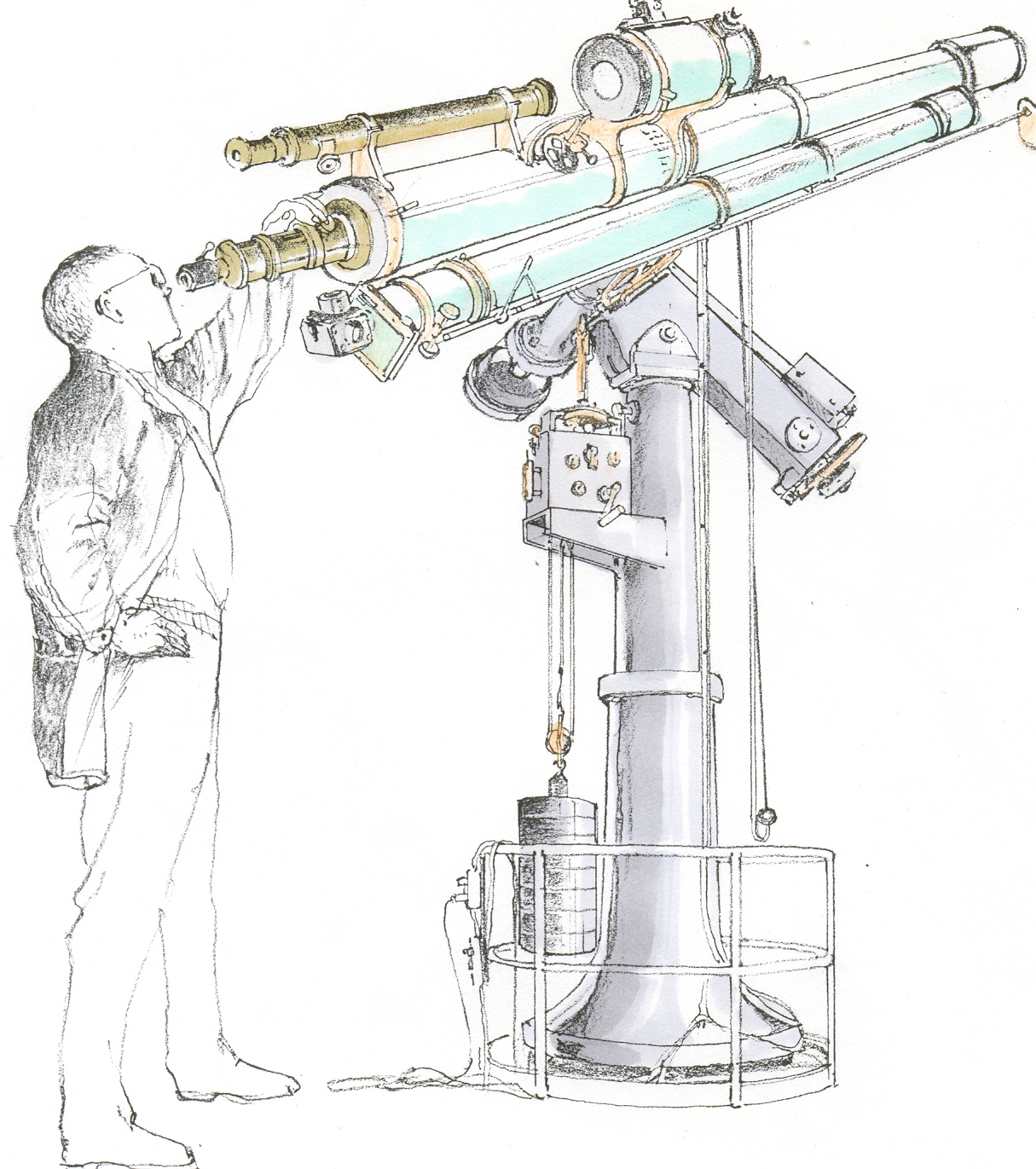
	<td><center>The refractor of the Urania Observatory, Aalborg, Denmark, as drawn by architect Arturo Hamo, MAA.</center></td>
</tr>
</table>
<br />

<table width="100%" border="0">
<tr align="left">
	<td><em><strong>1. The main refractor</strong></em><br />
  <em>The tube and mounting, including the mechanical drive, was manufactured by the firm of Th. Cooke &amp; Sons Ltd., London &amp; York in 18dd. The total length of the telescope's riveted tube from the dew cap to the fully extended ocular is nearly five meters. For more than hundred years the whole construction has proven its solidity and with the brass parts refurbished it presents an impressive sight.</em>
  </td>
</tr>
<tr align="left">
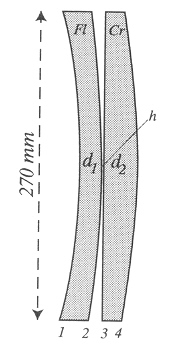
	<td><em><strong>2. The Gauss objective of the main telescope</strong></em><br />
  <em>Aperture 246 mm, glass diameter 270 mm, focal length 4067 mm. Manufactured by Carl Zeiss, Germany. An excellent and rather advanced objective.</em>
<table width="100%" border="1">
<tr>
	<td><em>Front glas, flint "Fl".</em><br />
          Indices of refraction:<br />
         <em>n</em><sub>C</sub> (red)  = 1.61484<br />
         <em>n</em><sub>D</sub> (blue)  = 1.61972<br />
         <em>n</em><sub>F</sub> (green) = 1.63193
  </td>
	<td rowspan="2" align="center"><img src="Billeder/Objektiv-snit.jpg" border="0" width="186" height="350" alt="Objektivsnit" /></td>
	<td rowspan="2">
    <em>Radii of curvature:</em><br />
         <em>r</em><sub>1</sub> = -542.29 mm<br />
         <em>r</em><sub>2</sub> = -880.76 mm<br />
         <em>r</em><sub>3</sub> = -5988.0 mm<br />
         <em>r</em><sub>4</sub> = -686.55 mm<br />
    <em>Glass thicknesses:</em><br />
         <em>d</em><sub>1</sub> = 16.5 mm<br />
         <em>d</em><sub>2</sub> = 25.5 mm<br />
    <em>Component distance:</em><br />
         <em>h</em> = 0.2 mm<br />
  </td>
</tr>
<tr>
	<td><em>Rear glass, crown "Cr".</em><br />
          Indices of refraction:<br />
         <em>n</em><sub>C</sub> (red)  = 1.51510<br />
         <em>n</em><sub>D</sub> (blue)  = 1.51770<br />
         <em>n</em><sub>F</sub> (green) = 1.52388
  </td>
	<td></td>
	<td></td>
</tr>
</table>
<br />
<table width="100%" border="1">
<tr align="center">
	<td><br />C-line, red<br />F-line, blue</td>
	<td><strong>Central ray</strong><br />4066.90 mm<br />4067.09 mm</td>
	<td><strong>First zone</strong><br />4066.93 mm<br />4067.00 mm</td>
	<td><strong>Second zone</strong><br />4066.99 mm<br />4066.99 mm</td>
	<td><strong>Rim ray</strong><br />4067.07 mm<br />4066.94 mm</td>
</tr>
</table>

</td>
</tr>
<tr align="left">
	<td><em><strong>3. The original clock drive</strong></em><br /><em>The telescope being constructed before the advent of electricity the drive is mechanical. The famous Danish watch maker Jens Olsen made some improvements to the drive and maintained it for many years. It woks well even today, but would need rewinding every half hour. For practical use the telescope is driven by an electical motor.</em></td>
</tr>
<tr align="left">
	<td><em><strong>4. Telescope for reading the declination circle</strong></em><br /><em>Made of brass (not visible on this drawing). The telescope allowes a convenient reading and setting of the declination from the ocular end.</em></td>
</tr>
<tr align="left">
	<td><em><strong>5. The hour circle</strong></em><br /><em>It is made of brass. Using long iron rods it is possible to adjust the telescope's hour angle. A vernier scale improves the accuracy.</em></td>
</tr>
<tr align="left">
	<td><em><strong>6. The "swan's neck"</strong></em><br /><em>Made of brass. Originally it was used in conjunction with an oil lamp to illuminate various auxillary instruments. Using mirrors, light was send through the telescope (perpendicular to the optical axis!) for illumination of the ocular end and the declination cicle. Is now equipped with a small battery lamp.</em></td>
</tr>
<tr align="left">
	<td><em><strong>7. The ocular end</strong></em><br /><em>Here you can mount oculars, cameras, ccd-camera, micrometer or. With various oculars magnifications between 100 and 1000 times can be achieved.</em></td>
</tr>
<tr align="left">
	<td><em><strong>8. The finder scope</strong></em><br /><em>Made by Reinfelder &amp; Hertel. Diameter 81 mm. This beautiful brass instrument has a fixed magnification of 20 times and provides a fine view of the entire Moon. A reticle greatly facilitates the finding of bright objects in the main telescope's field of view.</em></td>
</tr>
<tr align="left">
	<td><em><strong>9. The photographic Merz telescope</strong></em><br /><em>With a diameter of 162 mm and a focal length of about 3200 mm this scope was mainly used by its first owner, Victor Nielsen (1855 - 1918), for photographing the Moon and double stars. Photography and subsequent measuring of plates constituted a major part of Mr. Nielsen's work with the telescope. Its objective is corrected for use with the blue-sensitive photographic plates of that time, and therefore the telescope is not much in use any more.</em></td>
</tr>
<tr align="left">
	<td><em><strong>10. Modern astronomical camera</strong></em><br /><em>This 200 mm Schmidt/Newton reflecting telescope is intended for photography of more extended areas of the sky. It has replaced a Voigtl&auml;nder portrait camera. Equipped with a ccd-camera it can be used for finding minor planets or supernovae.</em></td>
</tr>
<tr align="left">
	<td><em><strong>11. Modern control box</strong></em><br /><em>With this box the telescope may be moved in hour angle and declination. It also provides a low current power outage for a ccd-camera and field illumination. Plans are at hand for connection with a computer for automatic positioning of the telescope and viewing of its pictures in the warm basement.</em></td>
</tr>
</table>

<p><img alt="----" align="middle" border="0" src="Billeder/RainbowLine.gif" width="100%" height="5" /></p>
<h2 align="center">Photo Gallery</h2>
<br />
<div style="text-align:center">Photos by <em>Torben Christensen</em></div>
<br />

<table border="1" width="100%">
<tr>
	<td align="center"><img src="Billeder/Kikkertbagende.jpg" border="0" width="393" height="576" alt="Kikkertbagende" /></td>
</tr>
<tr align="left">
	<td><center>The ocular end of the telescope. The white knob seen above and to the left is used for locking the telescope in hour angle. Below and to the right the white control panel for steering the telescope. <em>Photo: Torben Christensen</em></center></td>
</tr>
</table>
<br />

<table border="1" width="100%">
<tr>
	<td align="center"><img src="Billeder/Nafa 001.jpg" border="0" width="530" height="800" alt="" /></td>
</tr>
<tr align="left">
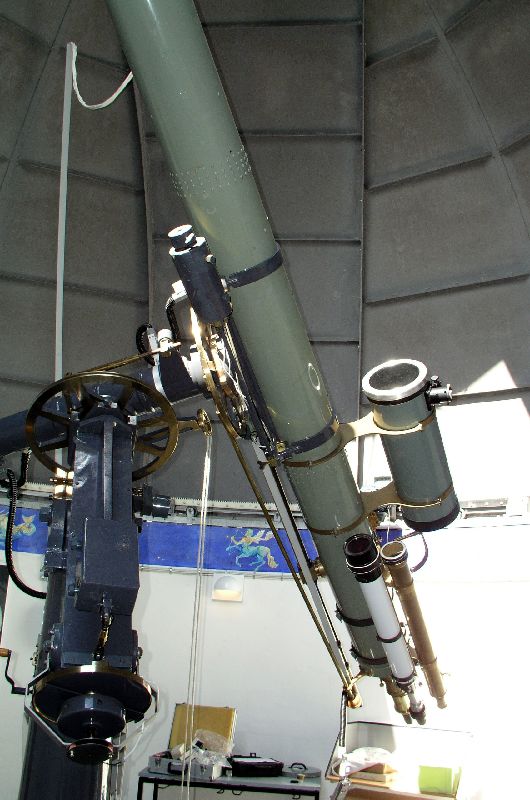
	<td>Auxilliary instruments:<br />With a white tube: Refractor equipped with a <em>Coronado</em> filter for observation of solar prominences.<br />With brass tube: The guiding telescope.<br />With grey tube: Reflecting telescope with a <em>Baader</em> solar filter.</td>
</tr>
</table>
<br />

<table border="1" width="100%">
<tr>
	<td align="center"><img src="Billeder/Nafa 003.jpg" border="0" width="800" height="530" alt="" /></td>
</tr>
<tr align="left">
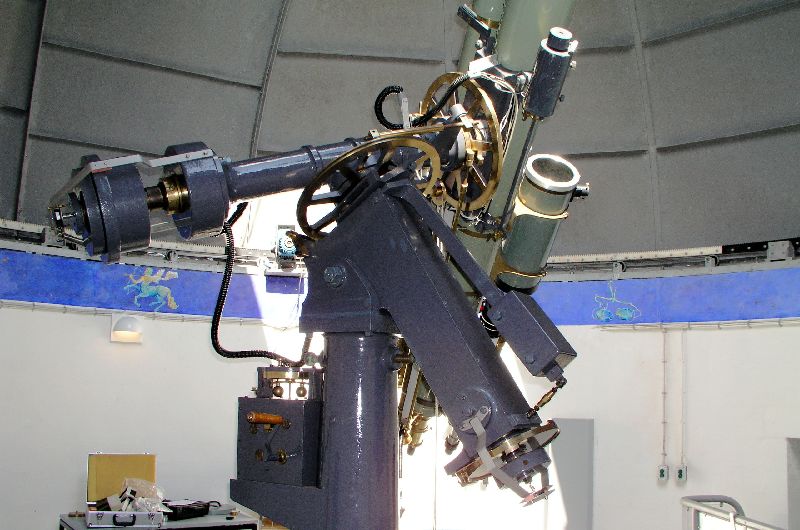
	<td><center>The German mount with contra weights. The crank for winding the mechanical drive is seen below and a little to the left.</center></td>
</tr>
</table>
<br />

<table border="1" width="100%">
<tr>
	<td align="center"><img src="Billeder/Nafa 006.jpg" border="0" width="800" height="530" alt="" /></td>
</tr>
<tr align="left">
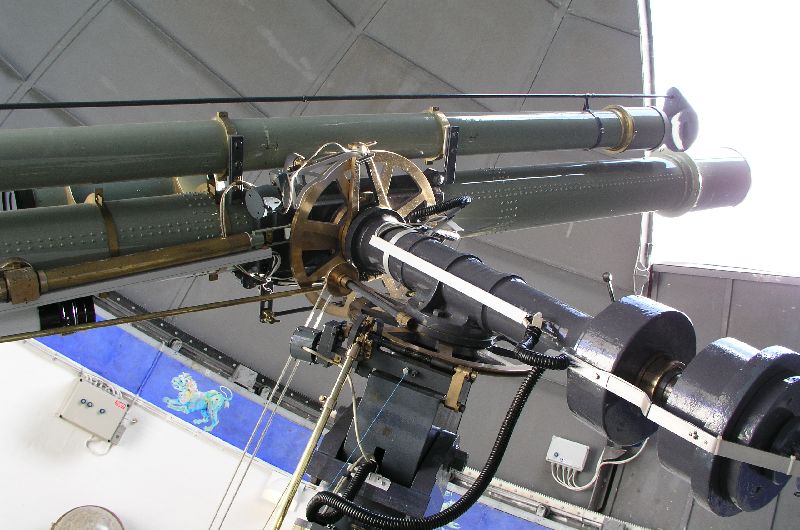
	<td><center>The photographic Merz telescope is here seen above the main one. Its objective may be covered by hand with a drop-shaped flap to control the exposure of the plate at the other end. Tha large central cogwheel is turned by a worm, which is driven either by the mechanical drive or by an electical motor with a cylindrical grey housing visible left of center.</center></td>
</tr>
</table>
<br />

<table border="1" width="100%">
<tr>
	<td align="center"><img src="Billeder/Nafa 004.jpg" border="0" width="530" height="800" alt="" /></td>
</tr>
<tr align="left">
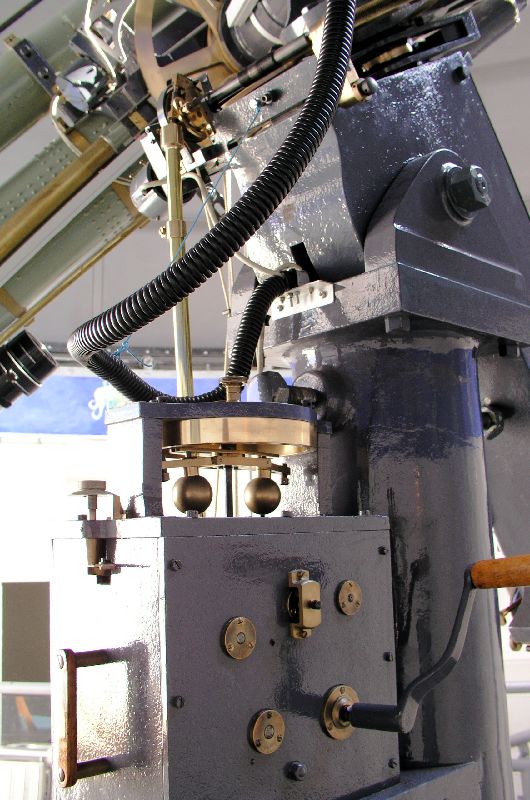
	<td><center>The crank-driven mechanical drive and brass centrifugal regulator. The vertical rod is turned quickly by the drive and will rotate the telescope once every 23<sup>h</sup>56<sup>m</sup> (one siderial day).</center></td>
</tr>
</table>
<br />

<table border="1" width="100%">
<tr>
	<td align="center"><img src="Billeder/Nafa 007.jpg" border="0" width="530" height="800" alt="" /></td>
</tr>
<tr align="left">
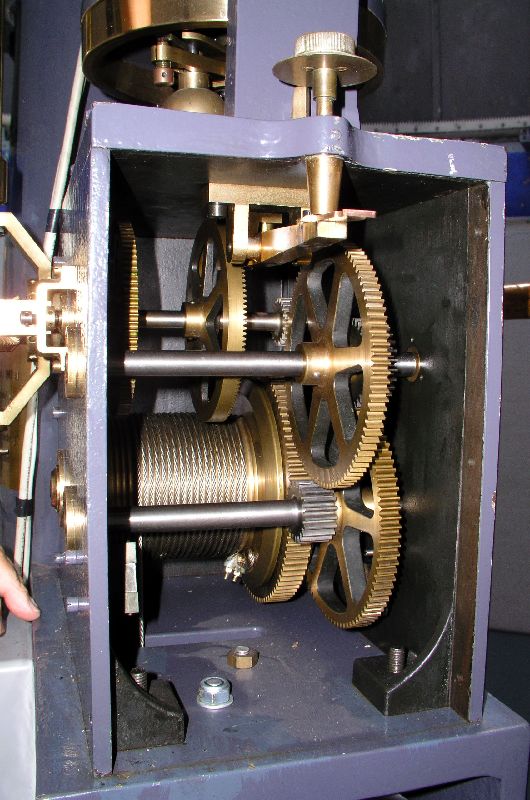
	<td><center>Here the back plate of the drive has been removed to reveil the gearing and the steel wire which holds eight lead weights, each at 20 kg.</center></td>
</tr>
</table>

<br />

    <div style="text-align:center">
    <a href="Urania-historie.htm#1988"><img src="Billeder/Up-hand.gif" border="0" width="12" alt="Retur!" /></a>
    </div>
     <p><img alt="----" align="middle" border="0" src="Billeder/RainbowLine.gif" width="100%" height="5" /></p>

    <p align="center">
    <a href="http://validator.w3.org/check?uri=referer">
    <img src="Billeder/valid-xhtml10.png" alt="Valid XHTML 1.0 Transitional" height="31" width="88" /></a>
    </p>

    </td>
  </tr>
</table>
  
<!-- WebWriter AutoDato -->Opdateret den 18.08.2006<!-- WW -->
</body>
</html>